
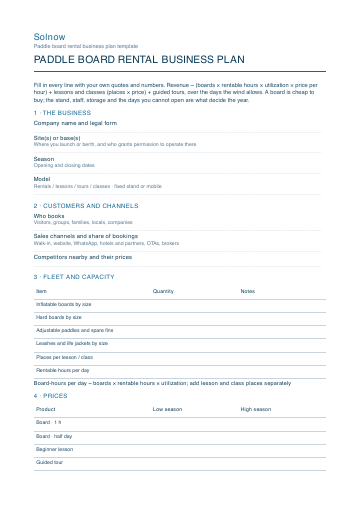
Sections for the paddle board fleet, the site, startup costs, prices, a capacity sheet and the season forecast, ready to fill in with your own numbers.
Is a paddle board rental business profitable?
Revenue ≈ (boards × rentable hours × utilization × price per hour) + lessons and classes (places × price) + guided tours, over the days the wind allows. A board is cheap to buy; the stand, staff, storage and the days you cannot open are what decide the year.
- Lessons and classes: a lesson sells for about twice an hour’s rental on the same board.
- Offshore wind: it is the condition that blows beginners away from shore, so it closes the stand and caps the season.
- Board choice: inflatables travel and store easily and survive drops; hard boards glide better but ding and need racks.
- Sizes: a light renter on a big board or a heavy renter on a small one ends the rental early.
- Fixed stand or mobile: a van that delivers boards to lakes and events reaches more water with the same fleet.
- Small losses: paddles, fins and leashes go missing unless they are listed on the agreement.
Source: rates set in Solnow by paddle board operators in Castellón, Spain, 2026 season. A lesson sells for twice an hour’s rental on the same board.
| Price | Source | |
|---|---|---|
| Paddle board · 30 min / 1 h · Spain | €10 / €15 | Solnow · two operators (30 min) and one (1 h) in Castellón, 2026 |
| Paddle board · 1 h · Mallorca / Barcelona | €16 / €15 | barcelo.com and guruwalk.com listings, Oct 2026 |
| Lesson · Spain | €30 | Solnow · one operator in Castellón, 2026 |
| Paddle board · 1 h · US | $20–35 | Three operators in FL, VA and MA (published rates, Oct 2026) |
A worked example with real numbers
Every figure below comes from the source next to it; nothing is estimated.
| Figure | Source | |
|---|---|---|
| Inflatable board (Tower Premium) | $449 | towerpaddleboards.com |
| Rental, 1 hour (US) | $20–35 | Published rates of three US operators |
| Rental hours to equal its price | $449 ÷ $20–35 = 13–22 hours | Calculated |
A board pays for itself in a couple of busy weeks. What decides the year is how many days the wind lets you open and how much of the revenue comes from lessons and classes.
Startup costs to budget
These are the lines your plan needs. The template has a row for each one; fill in your own quotes rather than an average from the internet.
- Boards in two or three sizes, inflatable or hard, plus spare fins.
- Adjustable paddles, leashes, life jackets in every size, and pumps for inflatables.
- Racks, a storage unit, and a trailer or van if you operate from more than one spot.
- Stand or booth, and the permit or concession for the launch spot.
- Instructor certification for whoever teaches lessons and classes.
- Wetsuits if the water is cold in your shoulder season.
- Insurance covering rentals, lessons and classes.
- Booking and waiver system that works from a QR code at the stand.
Published prices we could check, with their source:
| Price | Source | |
|---|---|---|
| Inflatable boards (Tower) | $349–549 | towerpaddleboards.com, Oct 2026 |
| Fleet discount (Tower, 5+ boards) | $30 off per board | towerpaddleboards.com, Oct 2026 |
| Insurance | Quote from a broker | No credible published premiums found; ask a watersports broker for a quote |
Inflatable boards usually ship with paddle, pump and leash; check what each package includes.
How to start a paddle board rental business, step by step
- 01Choose water that is sheltered from offshore wind, and get permission to rent there.
- 02Decide inflatable, hard or a mix, and buy sizes for the renters you expect.
- 03Certify at least one instructor before you sell lessons.
- 04Design the formats: hourly rental, beginner lesson, guided tour, sunset or yoga session.
- 05Get insurance that names every format you sell.
- 06Set up booking and waivers so renters sign before they reach the water, or at the stand from a QR code.
- 07Write the wind rule (who closes the stand and when) and the rebooking policy.
What goes in a paddle board rental business plan
The template has one section for each of these, written for paddle boards; fill them in with your own quotes.
- Fleet by type and size, with the expected life of each board.
- Formats and schedule: rentals, lessons, tours and classes, with places and prices.
- Wind calendar: months, and the share of days you expect offshore wind to close the stand.
- Fixed stand or mobile: the van, the trailer and the spots you will serve.
- Instructor cost: certification, hours and who covers lessons on busy days.
- Small-equipment budget: paddles, fins and leashes lost or broken each season.
Insurance for a paddle board rental business
For SUP, the format you sell changes the cover: an insurer looks differently at an unsupervised rental, a lesson with an instructor and a yoga class on the water. List every format when you ask for a quote.
- General liability for rentals: injury or damage to others caused by renters.
- Professional or instructor liability for lessons, tours and classes.
- Equipment cover for boards and paddles against theft from the beach and storm damage.
- Vehicle cover for the van or trailer if you deliver boards.
What the insurer will ask about your operation:
- Which formats you sell, and whether classes such as SUP yoga are included.
- Instructor certifications and the instructor-to-participant ratio.
- Your leash and life jacket policy.
- Your offshore wind rule and the area renters may paddle in.
- Signed waivers for every participant, including guardians for minors.
Permits, licences and insurance
Run it from day one without paper
The plan assumes a desk that can keep up in peak weeks. With Solnow, customers book and pay online or on WhatsApp, sign the rental agreement on their phone before they arrive, and walk-ups check in from a QR code, so the paddle boards spend their time on the water instead of waiting for paperwork.


