
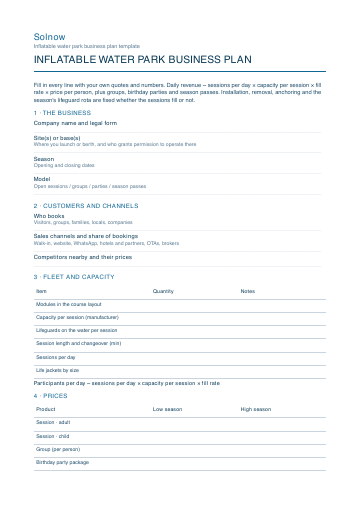
Sections for the module fleet, the site, startup costs, prices, a capacity sheet and the season forecast, ready to fill in with your own numbers.
Is an inflatable water park business profitable?
Daily revenue ≈ sessions per day × capacity per session × fill rate × price per person, plus groups, birthday parties and season passes. Installation, removal, anchoring and the season's lifeguard rota are fixed whether the sessions fill or not.
- Fill rate on weekdays: weekends sell out, and the season is made or lost on the weekday sessions.
- Capacity per session: set by the course and by how many lifeguards are on the water, not by demand.
- Session length: shorter sessions mean more turns per day but more changeover time.
- Groups: schools, summer camps and parties fill weekday mornings at a fixed price.
- Water temperature and weather: they set the opening and closing dates and close sessions on bad days.
- Wear and repairs: punctures and UV damage take modules out of the course mid-season.
We have no inflatable park among Solnow operators with data we can publish, so this page has no session prices of our own. The equipment prices below are published dealer prices.
Startup costs to budget
These are the lines your plan needs. The template has a row for each one; fill in your own quotes rather than an average from the internet.
- Inflatable modules for the course layout, from a manufacturer with installation guidance.
- Anchoring and mooring system for the site's depth and bottom.
- Installation and removal each season, and winter storage for the modules.
- Blowers or compressors and repair kits.
- Life jackets in every size, rescue boards and first aid.
- Lifeguards: certification, uniforms and a full-season rota.
- Water concession and permits, and insurance.
- Booth, lockers and a booking and waiver system with guardian consent for minors.
Published prices we could check, with their source:
| Price | Source | |
|---|---|---|
| Large commercial module (Aquaglide Kaos) | $6,639.99 | barts.com dealer list, Oct 2026 |
| Smaller modules (Swimstairs XL / Plunge Slide) | $1,029.99 / $979.99 | barts.com dealer list, Oct 2026 |
| Anchoring: anchor bag set / vertical mooring line | $114.99 / $113.99 | barts.com dealer list, Oct 2026 |
| Complete park | Quote only | Manufacturers do not publish complete-park prices |
| Insurance | Quote from a broker | No credible published premiums found; ask a watersports broker for a quote |
A park is several modules plus anchoring, installation and lifeguards; ask the manufacturer for a quote on your layout.
How to start an inflatable water park business, step by step
- 01Find the water and get the concession or permit to anchor there for the season.
- 02Choose the manufacturer and layout, and take their capacity, depth and age guidance as your limits.
- 03Plan lifeguard staffing per session before you set session sizes.
- 04Get liability insurance for participants on the course before installation.
- 05Install and anchor following the manufacturer's instructions, and keep a daily inspection log.
- 06Set the session grid and capacity, and sell groups and parties for weekday mornings.
- 07Have every participant sign a waiver, with a guardian signing for each minor, before they reach the booth.
What goes in an inflatable water park business plan
The template has one section for each of these, written for inflatable modules; fill them in with your own quotes.
- Course and capacity: modules, layout and the capacity per session the manufacturer and your lifeguards allow.
- Session grid: sessions per day, length and changeover time.
- Fill-rate forecast: weekdays and weekends, month by month.
- Season cost of installing, removing and storing the course.
- Lifeguard rota: cost per session and for the season.
- Group sales: schools, camps and parties, with their prices.
Insurance for an inflatable water park business
For a floating park, the cover that matters most is liability for participants on the course; equipment cover for the modules is the second line. Insurers will want to see how the course is installed, inspected and supervised.
- Public or general liability for participants and visitors.
- Equipment cover for modules and anchoring against storms, punctures and vandalism.
- Employer's liability or workers' compensation for lifeguards and staff.
- Business interruption for closures caused by damage to the course.
What the insurer will ask about your operation:
- The manufacturer, the installation and who certified the anchoring.
- The daily inspection log: inflation, anchors, seams.
- Lifeguard qualifications and how many are on the water per session.
- Minimum age and height, mandatory life jackets, and the safety briefing before each session.
- Signed waivers for every participant, with guardian consent for minors.
Permits, licences and insurance
Run it from day one without paper
The plan assumes a desk that can keep up in peak weeks. With Solnow, customers book and pay online or on WhatsApp, sign the rental agreement on their phone before they arrive, and walk-ups check in from a QR code, so the inflatable modules spend their time on the water instead of waiting for paperwork.


